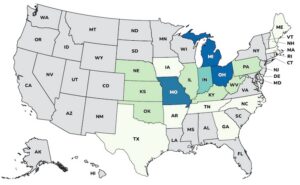
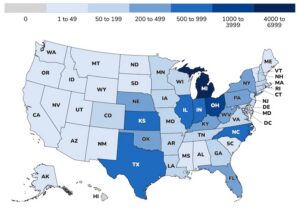
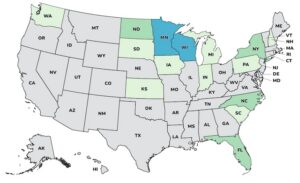
The nationwide cyclospora outbreak keeps growing, according to the Centers for Disease Control and Prevention (CDC). As of August 11, 2026, there are 13,895 confirmed cases and an additional 10,455 possible cases. Seven hundred forty people have been hospitalized, and two people, who lived in Michigan, have died.
These numbers are much lower than the individual state case counts. But even with the CDC’s lower number, using the multiplier of 83.1, there could be as many as 2,000,000 Americans sick with this parasitic infection this summer. In comparison, there were 1,180 cases of this infection last year.
The states were sick people live include Alabama, Alaska, Arizona, Arkansas, California, Colorado, Connecticut, Florida, Georgia, Idaho, Illinois, Indiana, Iowa, Kansas, Kentucky, Louisiana, Maine, Maryland, Massachusetts, Michigan, Minnesota, Mississippi, Missouri, Montana, Nebraska, Nevada, New Hampshire, New Jersey, New York, North Carolina, North Dakota, Ohio, Oklahoma, Oregon, Pennsylvania, Rhode Island, South Carolina, South Dakota, Tennessee, Texas, Utah, Vermont, Virginia, Washington, West Virginia, Wisconsin, and Wyoming, as well as in Washington D.C. and Puerto Rice. The hardest hit states are Michigan, Ohio, Illinois, Indiana, and North Carolina. The only states without cases are Delaware, New Mexico, and Hawaii.
Government agencies are investigating multiple clusters of cyclospora cases. The largest is the 15 state outbreak including Michigan and Ohio, which are allegedly linked to Taylor Farms de Mexico iceberg lettuce that was imported from central Mexico and served at Taco Bell restaurants.
Illness onset dates range from May 1, 2026 to August 2, 2026. The patient age range is from 1 to 98 years. There is a six week reporting lag between when people get sick and they see a doctor, are diagnosed, and when the illness is reported to public health officials. Which means case counts will continue to increase.
The CDC and state agencies have used traceback, exposure information, and lab tests to collect data in this outbreak. Many of the products that are named have multiple ingredients, such as salsa and guacamole, which makes it more difficult to narrow the contamination down to a single food. And the cyclospora parasite is much harder to identify in food since whole genome sequencing doesn’t work on it, and finding the microscopic parasite in huge quantities of food is very difficult.
For now, if you are in a high risk group for serious complications from foodborne illness, think about avoiding eating fresh raw produce. Cooked produce is just as healthy and will be safer. Remember that produce rinses, vinegar, and simply rinsing food will not remove the parasite, and freezing does not destroy it. And learn the symptoms of cyclosporiasis, so if you do get sick you can see your doctor and get treatment early.