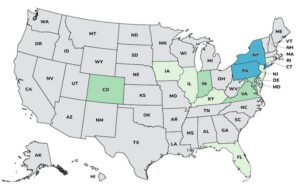
A Salmonella Agbeni outbreak linked to ice in a contaminated cooler at the Brown county fair in Illinois in 2024 sickened at least 13 people, according to the CDC’s Morbidity and Mortality Weekly Report (MMWR).

The outbreak was discovered when the Brown county sheriff told the Health Department that many potential jurors who were being screened for a trial had reported being sick with a gastrointestinal illness at the end of the fair. One week later, a lab confirmed case of Salmonella Agbeni was reported by the Illinois Department of Public Health.
An investigation found that there were seven lab confirmed and six probable cases of Salmonella Agbeni infection across five Illinois counties. All of the confirmed patients had attended the Brown County fair from July 30 to August 4, 2024, and reported drinking beer served from a cooler in the fair’s beer tent. No other common food or environmental exposures were reported.
This outbreak was unusual in that a generative artificial intelligence tool (ChatGPT 4.0, OpenAI; 2024) was used to generate a hypothesis of the outbreak. AI was not used for case finding, exposure assessment, or primary data analysis.
Traditional methods of patient interviews and traceback identified the shared, nonfood vehicle of transmission. The confirmed cases all drank beer at the fair. the six probable patients had close contact with the seven lab confirmed cases.
Interviews with people who had worked at the beer tent found that the cooler that held cans of beer was the problem. It was made of a 120 foot length of non food grade corrugated black plastic farm drainage tile with four internal compartments. The cooler was rinsed out with a hose once at the beginning of the fair, and was not rinsed again. It was never cleaned with soap. No means for monitoring the cooler’s internal temperature was available, and the cooler did not drain adequately, leading to standing water. Handwashing stations were not available in the beer tent, and staff members handled the ice and cans with bare hands.
Ice can become contaminated if handled or stored improperly. This is most often linked to inadequate ice-machine sanitation and handling.
The questions asked of ChatGPT helped narrow the focus of the investigation. Answers indicated that Salmonella could grow in standing meltwater combined with hot summer days and lack of sanitation. In addition, Salmonella contaminated meltwater on the outside of beverage cans, followed by hand-to-mouth transfer of bacteria, was a plausible route of exposure. The AI response also suggested ttat ice contamination is often an overlooked transmission vector.
The outbreak underscores the role of implementing and enforcing food sanitation and hygiene practices and the prevention of cross-contamination in community event settings.