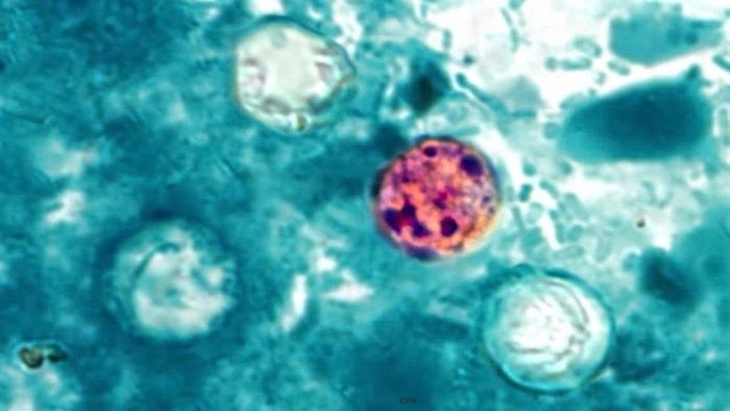
How big is the nationwide cyclospora outbreak (or outbreaks)? Let’s take a closer look at the numbers from the states affected by this parasite. The numbers vary depending on the source, which can be confusing.
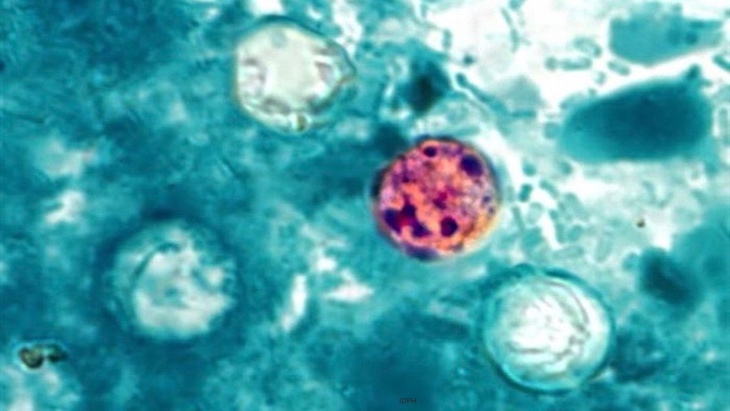
About Cyclospora
Cyclospora is a microscopic parasite that is transmitted through the fecal oral route. The means that when someone uses the bathroom and doesn’t wash their hands, or does a poor job, they can transfer the parasite to food or drink. Then when someone eats or drinks the contaminated food, they can get sick.
You can see the life cycle of the parasite in a diagram from the CDC. It can take a few weeks from consuming the parasite to suffering from symptoms. Sporozoites that emerge from oocysts in the intestines invade the epithelial cells. That causes inflammation and disrupts your intestines ability to hold onto nutrients and water. The result is unpredictable explosive diarrhea.
The foods that have been linked to cyclospora outbreaks in the past include cilantro, raspberries, basil, vegetable trays, snow peas, bagged salad mixes, and lettuce. These foods have wrinkled or crenelated surfaces where the parasite can hide. That means that rinsing or scrubbing produce may not remove all of the cyclospora oocysts. And rinsing with baking soda or vinegar in water is not completely effective against this pathogen. The only way to destroy it is by cooking; freezing doesn’t destroy cyclospora.
It can be difficult to diagnose cyclosporiasis because the parasite is shed inconsistently. Several stool samples across several days may be necessary for a diagnosis. And routine stool tests do not test for cyclospora. Your doctor must order a special test.
And this is startling: the multiplier for cyclospora, which is the number public health professionals multiply reported case counts by to get a good estimate of the actual outbreak size, is 83.1. That is the largest number for any pathogen. For comparison, the multiplier for Salmonella is 3.1.
The CDC and FDA
The CDC stopped tracking all of the foodborne pathogens through the Foodborne Diseases Active Surveillance Network (FoodNet) in July 2025. They now only track Salmonella and Shiga toxin-producing E. coli (STEC). The agency has eliminated tracking for Campylobacter, cyclospora, Listeria monocytogenes, Shigella, Vibrio and Yersinia. And almost half of the collected data had unexplained pauses.
The CDC says they are still tracking cyclospora, but their numbers in the latest officials report are woefully undercounted. The official number from that federal agency as of July 1, 2026, the latest update, is 145 cases in 17 states. The newest update, on July 9, 2026, is 843 cases in 25 states.
And according to the FDA’s latest CORE Outbreak Investigation Table, there are currently four cyclospora outbreaks, with case counts totaling 35 patients.
The States
According to the CDC, there are 17 states reporting cyclospora outbreaks. There are 43 states where cyclospora is a reportable illness. That means when doctors diagnose a cyclosporiasis infection, they must report it to state health officials.
These are the states reporting Cyclospora outbreaks along with case counts. These counts are accurate as of July 9, 2026, but are changing rapidly.
Michigan: 1562
Ohio: 661
New York: 394
Illinois: 161
North Carolina: 145
Colorado: 90
Florida: 50
Texas: 48
Wisconsin: 35
Pennsylvania: 28
Connecticut: 23
Louisiana: 23
Massachusetts: 18
Virginia: 10
These case counts have been mentioned in news reports but no site offers any links:
Georgia: 10
New Jersey: 10
Tennessee: 7
Alaska: ?
This is a total of 3,275 cases. Using the multiplier, there may be more than 272,000 Americans sick with this parasite. If there’s one thing that’s definite, it’s that this outbreak or outbreaks are going to continue to grow rapidly.
If you have been experiencing the symptoms of a cyclospora infection, see your doctor. You may be part of this nationwide cyclsopora outbreak.
Taco Bell
On July 9, 2026, Taco Bell pulled some fresh produce from some of its restaurant locations. The items were cilantro, guacamole, pico de gallo, onion, and lettuce. There is no indication that Taco Bell is the source of the pathogen in this outbreak or outbreaks. But it does make sense that with such a large outbreak or outbreaks, a chain store or restaurant with many outlets could be involved.
There are more than 8,000 Taco Bell restaurants in the United States. And there are Taco Bell restaurants in every state.
How to Protect Yourself
It can be very difficult, if not impossible, to completely protect yourself against this parasite if you eat fresh, uncooked produce. Thoroughly washing every piece of produce may help, but is not a 100% guarantee of protection. The only sure fire way to protect yourself and your family is to cook everything.
That may sound extreme, but if anyone in your family is in a high risk group for serious complications from infections, particularly dehydration, you may want to take that step. For instance, choose greens that are usually cooked, such turnip greens, collard greens, spinach, or chard instead of romaine or leaf lettuce. Use dried herbs instead of fresh. You may want to avoid eating out during this time as well.
Avoid fruits and vegetables with wrinkled surfaces, such as avocados, raspberries, blackberries, cantaloupe, broccoli, cauliflower, cabbage, and onions, unless they are cooked.
And always pay attention to FDA and USDA recalls. You can stay up to date with the latest food recalls by visiting those sites or by subscribing to Food Poisoning Bulletin.

If you have been sickened with a food poisoning infection, please contact our experienced attorneys for help with a possible lawsuit at 1-888-377-8900 or text us at 612-261-0856. Our firm represents clients in lawsuits against grocery stores, restaurants, and food processors.